By J.P. Irie
When Atlanta floods, it’s often not for lack of solutions but lack of follow-through. When the Creeks Rise spoke with Sarah Ledford, a Georgia State University associate professor and urban hydrologist, about what the metro could do differently. Many flood-prevention tools and policies exist but suffer from weak oversight and enforcement. Atlanta has so many competing priorities—like creating affordable housing and addressing public safety—that some inevitably fall behind.
Here are five ways Atlanta could better protect its communities.
Make flood data more easily available.
To prepare for floods, we should know where they happen. The Federal Emergency Management Agency has maps of flood-prone areas, but they’re often outdated and don’t account for impervious surfaces like concrete and asphalt. Insurance companies and realtors often have better models of flood probability than FEMA, but they don’t widely publish them, in part because a home’s value might plummet if buyers learn it’s in a high-risk area. “The modeling is out there, but people really don’t want to share it because they might get sued,” Ledford says. Zillow, for instance, recently stopped displaying climate risk scores, including flooding probabilities, directly on its listings after the real estate industry and homeowners complained the data was inaccurate and hurt property values.
“The modeling is out there, but people really don’t want to share it because they might get sued.”
—Sarah Ledford, Georgia State University associate professor and urban hydrologist
Limit impervious surfaces.
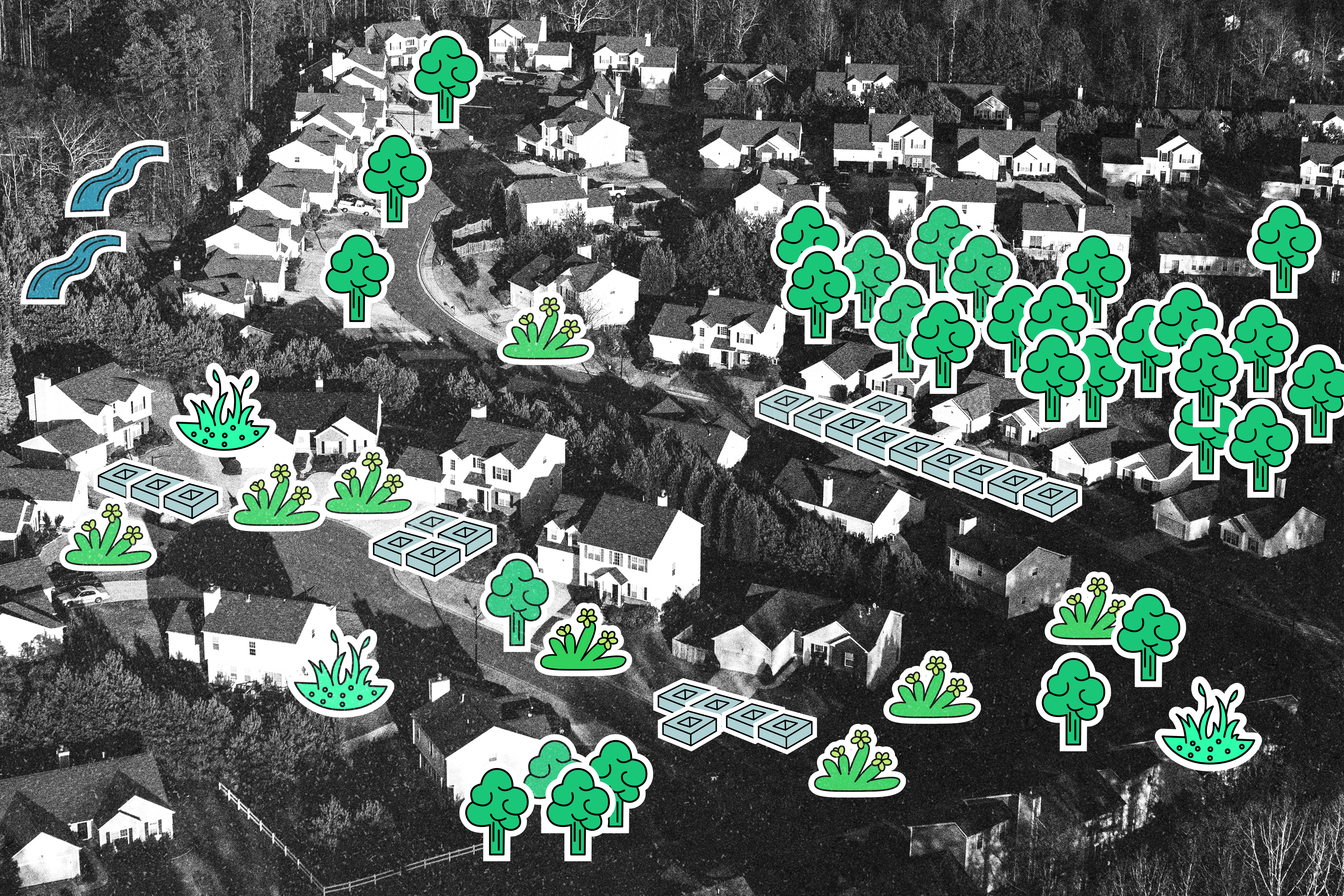
Materials like concrete, asphalt, and steel leave runoff nowhere to go. Some solutions include building for higher density within smaller footprints and restoring green space to the remaining land; uncovering and restoring buried creeks and streams; and enforcing stormwater drainage standards on new developments, like requiring rain barrels or other runoff devices.
Create and protect green space.
Plants act like natural sponges, and the “city in a forest” could stand to use them to its advantage. Most people look to the tree canopy, but Ledford points out that Atlanta’s aging trees are hard to maintain due to the high cost of arborists. Planting and preserving shrubbery and other small plants is an easy, sustainable step toward soaking up more stormwater. “Large tree canopy is really important but only if you can maintain it,” she says.
Build green infrastructure.
Atlanta, like other cities, has a lot of what urbanists call “grey infrastructure,” like roads and concrete structures that don’t soak up much water. Green infrastructure is designed to work with the natural environment rather than against it. Think rain gardens, bioswales (shallow channels that filter runoff), and permeable pavers. But green infrastructure, like grey infrastructure, requires investment and maintenance. “You can’t put them in and walk away forever,” Ledford says. “They require a consistent budget line item, and that has really not happened in Atlanta.” Other cities, like Philadelphia, incentivize homeowners to be a bit more proactive, too, by offering them free rain barrels and subsidies for rain gardens and other stormwater tools.
Make standards mandatory.
Preparing for floods, building better infrastructure, and protecting green spaces all require sustained collaboration among city departments, county governments, and even the Atlanta Regional Commission. That means not working in silos and, more importantly, having standards that everyone adheres to. For example, the Department of Watershed can collaborate with Parks and Recreation on green space to control runoff and flooding, or it can collaborate with Transportation on installing and maintaining permeable pavers. “Maybe we start by having conversations and building relationships, but at some point, things need to become requirements,” Ledford says. “If everything stays optional, it’s really easy for people to get out of it.”
“Maybe we start by having conversations and building relationships, but at some point, things need to become requirements.”
—Sarah Ledford, Georgia State University associate professor and urban hydrologist

Leave a Reply