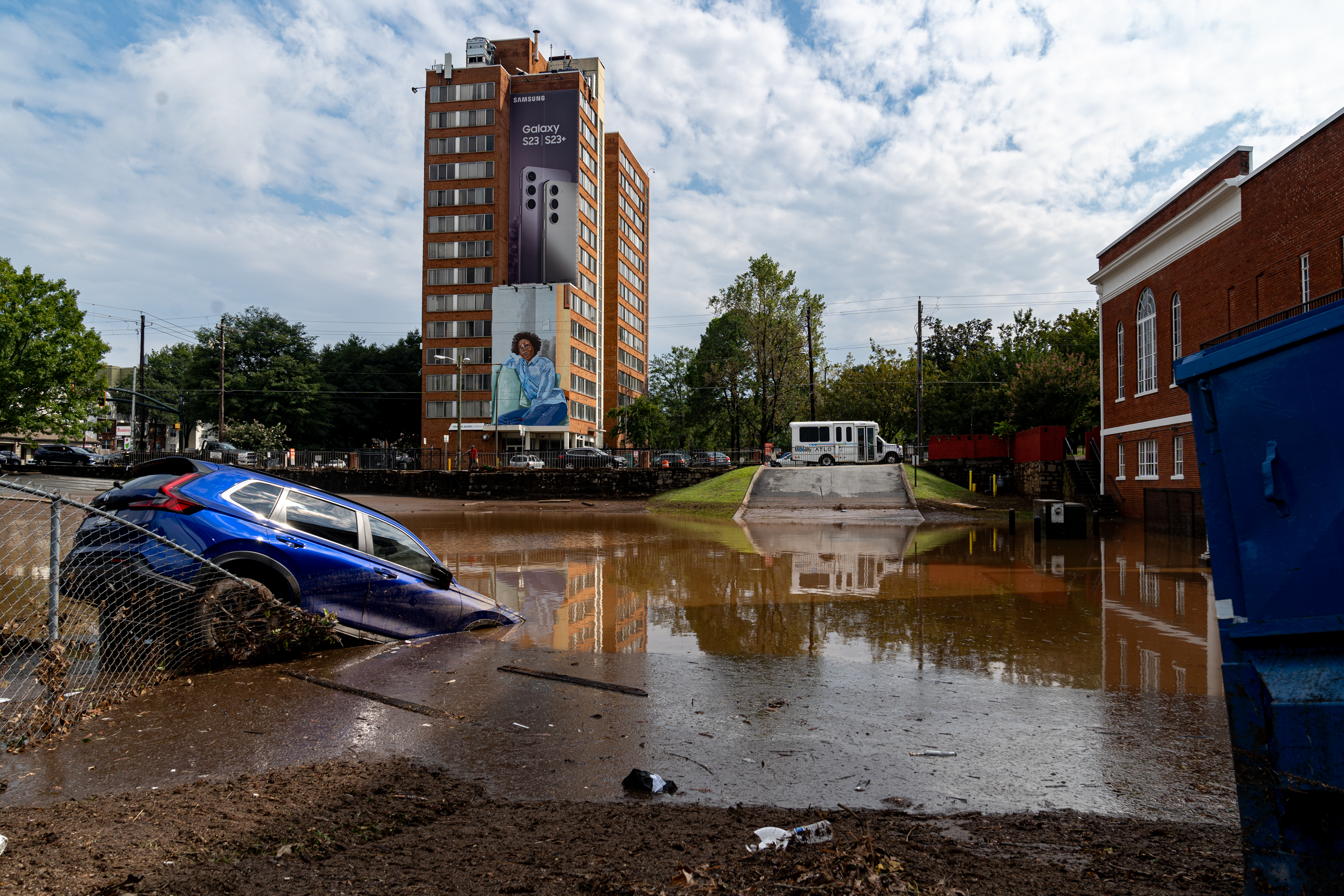
In September 2024, Tropical Storm Helene brought heavy rainfall to Atlanta, triggering a flash flood emergency. Neighborhoods flooded, roads washed out, and critical infrastructure gaps were exposed. But it doesn’t take extreme weather events to overwhelm some parts of the city.
Downtown Atlanta’s Gulch—a 40-acre site of parking lots and rail lines below street level—generates massive stormwater runoff even during moderate rains, sending millions of gallons downstream to inundate nearby streets, businesses, and communities. Despite billions in public tax incentives for the Centennial Yards development at this site (one of the largest incentive packages in City history), construction has proceeded with a stormwater management plan that critics argue is insufficient to fully capture the Gulch’s massive runoff and to protect flood-prone downstream neighborhoods.
When the Creeks Rise asked candidates how they would push for integrated, equitable, and resilient stormwater solutions citywide. Here’s how they responded.
| Within 90 days of taking office, will you commit to holding or supporting a city committee hearing to review flooding from the Gulch and to study the feasibility of capturing at least 36 million gallons of stormwater at the site? The Gulch generates significant stormwater runoff that flows into nearby neighborhoods. Advocates estimate that capturing and storing at least 36 million gallons of water from the Gulch would help prevent flooding in these downstream communities. A city committee hearing would allow residents, technical experts, and city officials to examine the scope of the problem, review engineering assessments, and evaluate potential solutions. This hearing should include testimony from affected residents, presentations from the Department of Watershed Management, independent engineering analysis, and consideration of how the ongoing Centennial Yards development can integrate flood mitigation infrastructure. | Byron D. Amos, Perrin Bostic, Jamie Christy, Steven Dingle, Harold Hardnett, Dustin Hillis, Toni Belin Ingram, Rohit Malhotra, Marci Collier Overstreet, Matt Rinker, and Thomas Worthy: |
| Within 90 days of taking office, will you push for the Department of Watershed Management to assemble a team of engineers, planners, public health specialists, and justice advocates tasked with creating a comprehensive stormwater plan for the Gulch? A comprehensive stormwater management plan should address both the technical and equity dimensions of flooding from the Gulch. The expert team should include civil and environmental engineers with stormwater expertise, urban planners familiar with green infrastructure, public health specialists who understand flooding’s health impacts, and environmental justice advocates who can ensure that solutions protect the communities downstream. The plan should identify specific volumes of water to be captured, evaluate underground cisterns and green infrastructure options like parks and bioswales, assess costs and timelines, and recommend funding mechanisms. This plan would serve as a blueprint for integrating flood mitigation into the Centennial Yards development. | Byron D. Amos, Perrin Bostic, Jamie Christy, Steven Dingle, Harold Hardnett, Dustin Hillis, Toni Belin Ingram, Rohit Malhotra, Marci Collier Overstreet, Matt Rinker, and Thomas Worthy: |
| Will you commit to pursuing funding for flood mitigation at the Gulch through sources such as the Capital Improvement Program, developer fees, Tax Allocation District revenues, a portion of the $2 billion taxpayer investment, and other mechanisms? Experts estimate that capturing 36 million gallons of stormwater runoff from the Gulch using underground cisterns and green infrastructure like parks could cost approximately $90 million. Potential funding sources include: the City’s Capital Improvement Program (which funds major infrastructure projects); developer impact fees from the Centennial Yards project; Tax Allocation District (TAD) bond proceeds (20 percent of which, up to $125 million, is designated for nearby communities); a portion of the nearly $2 billion in public tax incentives committed to the Gulch development; federal Infrastructure Investment and Jobs Act funding; EPA water infrastructure grants; and green bonds or climate resilience financing. Given the scale of public investment in this site, flood mitigation should be considered a core infrastructure requirement rather than an optional amenity. | Byron D. Amos, Perrin Bostic, Jamie Christy, Steven Dingle, Harold Hardnett, Dustin Hillis, Toni Belin Ingram, Rohit Malhotra, Marci Collier Overstreet, Matt Rinker, and Thomas Worthy: |
The following candidates did not respond to our survey:
Post 1 At-Large: Michael Julian Bond, Juan Mendoza. Post 2 At-Large: Matthew Westmoreland. Post 3 At-Large: Eshé Collins. District 1: Jason Winston. District 2: Kelsea Bond, William Jacob Chambers, Alex Bevel Jones, Rod Mack, Courtney Smith, James White III. District 4: Jason Dozier, Sister Deborah Williams. District 5: Liliana Bakhtiari. District 6: Alex Wan. District 7: Allen Daly, Thad Flowers, Rebecca King. District 8: Mary Norwood. District 9: Charles Bourgeois. District 10: Andrea Boone. District 11: Andre Burgin, Curt Collier, Nathan Jester, Wayne Martin, Reginald Rushin. District 12: Delvin Davis, Stephanie Flowers, Antonio Lewis.
Byron D. Amos, District 3

How will you ensure authentic engagement with flood-affected communities to shape stormwater solutions, hold the City and developers accountable, and guarantee transparency so residents know how funds are being spent and what progress is being made?
Meaningful community engagement for stormwater solutions requires accessible processes for residents in flood-prone communities to participate in decision-making from the beginning. This could include: convenient, in-neighborhood meetings, translation and childcare, compensating community experts, establishing oversight committees with real power, and/or creating strong accountability mechanisms. How will you ensure these communities have a voice in designing and implementing solutions?
Byron D. Amos: I will ensure authentic engagement with flood-affected communities by embedding accountability, transparency, and community leadership into every phase of stormwater planning and implementation. I will re-establish the Proctor Creek Advisory Board, which was made up of residents from flood-impacted neighborhoods, environmental justice advocates, and public health experts. I would also use our NPUs as a mechanism to share information.
With climate change driving more frequent and intense rainstorms that outpace existing infrastructure, how will you ensure Atlanta invests in equitable, livable, and resilient stormwater solutions that protect all residents across the city?
Climate scientists project that Atlanta will experience more extreme rainfall events in the coming decades, with storms that once occurred every 100 years now happening more frequently. The city’s aging stormwater infrastructure—much of it built decades ago—cannot handle these increased flows. A climate-resilient approach requires: upgrading and expanding stormwater infrastructure citywide, not just in wealthy neighborhoods; investing in green infrastructure like parks, rain gardens, and permeable surfaces that absorb water naturally; updating development standards to require flood mitigation in new construction; prioritizing protection for historically underserved communities that face disproportionate flooding impacts; coordinating across city departments to integrate stormwater planning with transportation, housing, and parks; and securing dedicated, long-term funding for maintenance and upgrades.
Byron D. Amos: I will ensure Atlanta invests in equitable, livable, and resilient stormwater solutions by demanding data-driven planning, community-led design, and multi-source funding, especially in neighborhoods most vulnerable to flooding and infrastructure failure. I would prioritize legacy neighborhoods with chronic flooding, aging infrastructure, and limited green space. I would champion green infrastructure and permeable pavement to absorb runoff and beautify communities. I would also retrofit public spaces like parks and schools to serve as stormwater capture locations.
Perrin Bostic, District 3

How will you ensure authentic engagement with flood-affected communities to shape stormwater solutions, hold the City and developers accountable, and guarantee transparency so residents know how funds are being spent and what progress is being made?
Meaningful community engagement for stormwater solutions requires accessible processes for residents in flood-prone communities to participate in decision-making from the beginning. This could include: convenient, in-neighborhood meetings, translation/childcare, compensating community experts, establishing oversight committees with real power, and/or creating strong accountability mechanisms. How will you ensure these communities have a voice in designing and implementing solutions?
Perrin Bostic: Authentic engagement starts with meeting people where they are, which is in their neighborhoods, on their schedules, and in ways that honor their expertise and experience. Communities like Grove Park and Center Hill, which continue to face severe flooding and outdated water infrastructure, must be at the center of stormwater planning. I would ensure residents from these and other flood affected areas are part of the process from the very beginning, not just informed after decisions are made.
That means hosting meetings in impacted neighborhoods with translation, childcare, and stipends for community members who contribute their lived experience. I support establishing a community oversight committee with real authority to monitor projects, track stormwater spending, and share progress updates publicly. I’ll also push for clear, accessible reporting and ensure developers are held accountable for runoff management and infrastructure responsibilities. Transparency, equity, and accountability must guide every step if we’re going to rebuild trust and deliver lasting solutions.
With climate change driving more frequent and intense rainstorms that outpace existing infrastructure, how will you ensure Atlanta invests in equitable, livable, and resilient stormwater solutions that protect all residents across the city?
Climate scientists project that Atlanta will experience more extreme rainfall events in the coming decades, with storms that once occurred every 100 years now happening more frequently. The city’s aging stormwater infrastructure—much of it built decades ago—cannot handle these increased flows. A climate-resilient approach requires: upgrading and expanding stormwater infrastructure citywide, not just in wealthy neighborhoods; investing in green infrastructure like parks, rain gardens, and permeable surfaces that absorb water naturally; updating development standards to require flood mitigation in new construction; prioritizing protection for historically underserved communities that face disproportionate flooding impacts; coordinating across city departments to integrate stormwater planning with transportation, housing, and parks; and securing dedicated, long-term funding for maintenance and upgrades.
Perrin Bostic: Atlanta’s stormwater system is extremely outdated and it simply wasn’t built for the climate realities we face today. With more frequent and intense weather events, like Hurricane Helene, we have to invest in equitable, livable, and resilient solutions that protect every neighborhood, not just those that have access to the most resources. This means upgrading outdated infrastructure in places like Grove Park and Center Hill, while also expanding green infrastructure that will naturally absorb water and reduce flooding. I’ll advocate for stronger development standards so new projects don’t worsen runoff, and for dedicated, long term funding to maintain and modernize our system.
We also need better coordination across city departments. Ensuring we’re linking stormwater planning with housing, transportation, and parks while also ensuring historically underserved communities are prioritized in these investments. Building a climate resilient Atlanta starts with fairness, transparency, and the understanding that every resident deserves safe, dry streets and homes.
Jamie Christy, District 7

How will you ensure authentic engagement with flood-affected communities to shape stormwater solutions, hold the City and developers accountable, and guarantee transparency so residents know how funds are being spent and what progress is being made?
Meaningful community engagement for stormwater solutions requires accessible processes for residents in flood-prone communities to participate in decision-making from the beginning. This could include: convenient, in-neighborhood meetings, translation/childcare, compensating community experts, establishing oversight committees with real power, and/or creating strong accountability mechanisms. How will you ensure these communities have a voice in designing and implementing solutions?
Jamie Christy: Flooding is a problem in many areas of Atlanta, District 7 included. All stormwater solutions must be driven by community input, backed by sound engineering, and be fiscally responsible. I recognize that some residents may be precluded from attending meetings in the day because of their jobs. Additional evening meetings should be scheduled to encourage residents who live in these areas to attend. These meetings could be held at churches, schools, or libraries as these are trusted locations in communities. The City also can partner with neighborhood associations in each flood-affected area to host sessions. These associations can coordinate childcare, recruit bilingual community members for translation purposes, as well as promote these meetings to ensure maximum attendance. Any written communications should be in the languages spoken in those communities. Another option to encourage participation is to provide a virtual platform which is cost-effective and will allow for maximum participation. I will work with a Council communications committee to schedule these meetings on a frequent and regular basis with sufficient notice so that all who are interested can attend. I am advocating for a dashboard on the City’s website that will update progress on flooding at a regular interval while detailing current and expected projects related to flooding remediation.
Any oversight committee must not come at the expense of the taxpayers. The oversight committee must include residents from the flood-impacted areas with a mix of renters and homeowners to provide different perspectives. The committee must include a civil or environmental engineer (or both) who has experience in stormwater management. These engineers could be professors from Georgia Tech or even Georgia State University who may donate their time to ensure the City is relying on the most efficient and viable methods to address the effects of flooding and to create systems that prevent flooding. Their compensation, if needed, would be through a professional service contract that falls under the Department of Watershed Management’s budget. The stipend would be tied to deliverables so that there would not be unnecessary spending. A representative from the Department of Watershed Management should play a role on the committee. This member would not have voting power but serve as a liaison between the committee and the City, as well as ensure the City and Council follow through on the committee’s recommendations.
The Council can enact ordinances implementing the recommendations. These ordinances can require developers and builders to provide needed infrastructure tied to or near the new development to address the stormwater recommendations. These ordinances can require developers and builders to strengthen their runoff mechanisms during construction. Reducing runoff will decrease the strain on the stormwater system and reduce flooding.
To provide transparency and accountability, the City must publish monthly reports detailing where the funds are being used as well as a timelines for stormwater projects on the website dashboard. If developers or other parties do not abide by the recommendations, then I would advocate for penalties or revocation of permits. Developers who profit from Atlanta’s growth must also protect Atlanta’s neighborhoods from its impact.
In sum, all residents in flood affected neighborhoods in Atlanta will have the opportunity to share their thoughts on flooding and to suggest ideas for flood prevention on a regularly scheduled basis. An oversight committee will digest the information provided on a planned calendar that anyone can attend for transparency. The committee will deliver to the Council and City departments suggestions for preventing flooding and addressing the effects of flooding while sharing those suggestions with all residents on the newly created dashboard. Resident input and community involvement around the City with open communication and full disclosure will be the impetus for improving flooding in Atlanta. City ordinances that ensure compliance and that provide a pathway for developers to shore up Atlanta’s stormwater system should be the final step. The oversight committee can ensure accountability.
With climate change driving more frequent and intense rainstorms that outpace existing infrastructure, how will you ensure Atlanta invests in equitable, livable, and resilient stormwater solutions that protect all residents across the city?
Climate scientists project that Atlanta will experience more extreme rainfall events in the coming decades, with storms that once occurred every 100 years now happening more frequently. The city’s aging stormwater infrastructure—much of it built decades ago—cannot handle these increased flows. A climate-resilient approach requires: upgrading and expanding stormwater infrastructure citywide, not just in wealthy neighborhoods; investing in green infrastructure like parks, rain gardens, and permeable surfaces that absorb water naturally; updating development standards to require flood mitigation in new construction; prioritizing protection for historically underserved communities that face disproportionate flooding impacts; coordinating across city departments to integrate stormwater planning with transportation, housing, and parks; and securing dedicated, long-term funding for maintenance and upgrades.
Jamie Christy: If elected, I will prioritize data-driven stormwater investments to protect all residents, as well as taxpayer resources. City Council must work with the Department of Watershed Management (DWM) so that funding will be used for the most flood-impacted areas. I support a mapping of the entire water and sewer pipes so the City can determine which pipes are most at risk for bursting. The City must repair or replace those pipes first to prevent flooding from a source that could have been avoided. Where applicable, I will advocate for using green infrastructure, such as permeable surfaces, rain gardens, and bioswales that absorb water runoff and reduce the burden on our current pipes. Like my previous answer, there must be an oversight committee for each district constructed in the same manner I described in my previous answer and for the reasons I previously explained. All funds in the stormwater budget must be traced throughout the project from beginning to completion. I will push for monthly reporting by DWM and also require annual audits that are verified by the City Auditor. Developers must also be held accountable: Permits will not be issued unless the plans include a verified runoff plan, post-construction inspections, and enforceable penalties for violations.
To prevent an increase in taxes to remedy these issues, I will explore state and federal resilience grants, like FEMA’s BRIC program and EPA clear water funds before turning to the taxpayers. The City must focus on building sustainable infrastructure while maintaining transparency and fiscal responsibility, rather than short-term fixes that fail once again.
As for the drainage maintenance schedules, Atlanta must be proactive, rather than reactive. I would require DWM and the Department of Public Works (DPW) to collaborate and develop a drainage maintenance master schedule that is updated annually. Atlanta would be divided into “maintenance zones” based on flood risk history, infrastructure age, topography/runoff volume, and community vulnerability (whether the area is senior-heavy or low-income, for example). Each of the zones would have a defined inspection and cleaning cycle. For example, a high-risk area must be inspected and the catch basins must be cleared and drained every 3-4 months. A moderate risk area would be inspected, cleared, and drained every 6 months; and a low-risk area would be inspected, cleared, and drained annually. DWM would be mandated to provide quarterly reports to City Council’s Transportation & Public Works Committees to provide reports on hotspots, the number of drains cleaned, and the costs.
311 is also a resource for citizens to report flooding. I would create a subcategory called “Stormwater Rapid Response” so that these calls are fast-tracked within 311. While not relevant to this question, I also will push for every department’s software to be integrated to avoid 311 reports falling through the cracks.
I will require developers to clear nearby drains during and after construction to prevent sediment blockages, and DWM and DPW must coordinate road resurfacing with drain cleaning. As an incentive for these departments, when fiscal metrics are met, these departments can retain or grow their budgets. If these departments operate under budget, then I would advocate for a percentage of those funds to be used for employee bonuses in that department.
I will endeavor to have these costs accounted for in DWM and DPW’s budgets. Maintenance costs, while they may seem expensive, are significantly cheaper than emergency repairs. If we are proactive, rather than reactive, we can save millions annually in flood damage and claims, avoid massive infrastructure failures, and use stormwater utility fees more efficiently as preventative funds, rather than disaster recovery.
Steven Dingle, District 11

How will you ensure authentic engagement with flood-affected communities to shape stormwater solutions, hold the City and developers accountable, and guarantee transparency so residents know how funds are being spent and what progress is being made?
Meaningful community engagement for stormwater solutions requires accessible processes for residents in flood-prone communities to participate in decision-making from the beginning. This could include: convenient, in-neighborhood meetings, translation/childcare, compensating community experts, establishing oversight committees with real power, and/or creating strong accountability mechanisms. How will you ensure these communities have a voice in designing and implementing solutions?
Steven Dingle: Reaching out to communities via housing/neighborhood associations, NPUs, and holding town halls with stormwater solution experts and explaining the issue and how to solve the problem and what they find will be the best steps to move forward. Establishing an oversight committee with real power, strong accountability mechanism, or holding the City accountable directly if none of the methods previously stated are agreed upon.
With climate change driving more frequent and intense rainstorms that outpace existing infrastructure, how will you ensure Atlanta invests in equitable, livable, and resilient stormwater solutions that protect all residents across the city?
Climate scientists project that Atlanta will experience more extreme rainfall events in the coming decades, with storms that once occurred every 100 years now happening more frequently. The city’s aging stormwater infrastructure—much of it built decades ago—cannot handle these increased flows. A climate-resilient approach requires: upgrading and expanding stormwater infrastructure citywide, not just in wealthy neighborhoods; investing in green infrastructure like parks, rain gardens, and permeable surfaces that absorb water naturally; updating development standards to require flood mitigation in new construction; prioritizing protection for historically underserved communities that face disproportionate flooding impacts; coordinating across city departments to integrate stormwater planning with transportation, housing, and parks; and securing dedicated, long-term funding for maintenance and upgrades.
Steven Dingle: Making the decision as early as possible to build and create proper infrastructure that makes Atlanta extremely climate-resilient. Being pro-active is always better than being reactive when it comes to preparing for the elements and the potential damage it could cause.
Harold Hardnett, District 11
How will you ensure authentic engagement with flood-affected communities to shape stormwater solutions, hold the City and developers accountable, and guarantee transparency so residents know how funds are being spent and what progress is being made?
Meaningful community engagement for stormwater solutions requires accessible processes for residents in flood-prone communities to participate in decision-making from the beginning. This could include: convenient, in-neighborhood meetings, translation/childcare, compensating community experts, establishing oversight committees with real power, and/or creating strong accountability mechanisms. How will you ensure these communities have a voice in designing and implementing solutions?
Harold Hardnett: I will ensure flood-affected communities hava a real voice in shaping stormwater solutions. That means hosting neighborhood meetings, providing translation and childcare, and flexible meeting times so all voices can participate.
Advocate for community compensation for local experts, organizers, and residents who give their time and insight to the process. Create an independent oversight committee to track progress and spending. Increase transparency by requiring regular public reporting, clear project timelines, and an online dashboard tracking spending and stormwater improvement progress.
Because the people who live with flooding every time it rains deserve to help design the solutions that will finally bring them relief.
With climate change driving more frequent and intense rainstorms that outpace existing infrastructure, how will you ensure Atlanta invests in equitable, livable, and resilient stormwater solutions that protect all residents across the city?
Climate scientists project that Atlanta will experience more extreme rainfall events in the coming decades, with storms that once occurred every 100 years now happening more frequently. The city’s aging stormwater infrastructure—much of it built decades ago—cannot handle these increased flows. A climate-resilient approach requires: upgrading and expanding stormwater infrastructure citywide, not just in wealthy neighborhoods; investing in green infrastructure like parks, rain gardens, and permeable surfaces that absorb water naturally; updating development standards to require flood mitigation in new construction; prioritizing protection for historically underserved communities that face disproportionate flooding impacts; coordinating across city departments to integrate stormwater planning with transportation, housing, and parks; and securing dedicated, long-term funding for maintenance and upgrades.
Harold Hardnett: Atlanta must take bold, equitable action to address flooding and climate resilience. I will champion investments in modern, citywide stormwater infrastructure and expand green solutions like rain gardens, permeable streets, and parks that natually manage runoff.
I’ll push to update development standards so new projects include strong flood protections and ensure historically underserved communities are prioritized, not left behind. I’ll advocate for dedicated funding and cross-department coordination so stormwater planning works hand-in-hand with housing, transportation, and parks to build a safer, more resilient Atlanta for everyone.
Dustin Hillis, District 9

How will you ensure authentic engagement with flood-affected communities to shape stormwater solutions, hold the City and developers accountable, and guarantee transparency so residents know how funds are being spent and what progress is being made?
Meaningful community engagement for stormwater solutions requires accessible processes for residents in flood-prone communities to participate in decision-making from the beginning. This could include: convenient, in-neighborhood meetings, translation/childcare, compensating community experts, establishing oversight committees with real power, and/or creating strong accountability mechanisms. How will you ensure these communities have a voice in designing and implementing solutions?
Dustin Hillis: Atlanta is one of the few remaining cities in the metro area without a stormwater utility. This has left us without a sustainable, dedicated funding source to address chronic flooding, outdated infrastructure, and worsening climate impacts. Once re-elected, I will request to chair the City Utilities Committee for 2026 to ensure we finally adopt a stormwater utility and begin to resolve many other long-standing issues within the Department of Watershed Management.
The utility must be designed equitably, with funds reinvested in the neighborhoods and watersheds most impacted by flooding and past neglect. Atlanta’s urban watersheds, like Proctor Creek and Utoy, each face unique challenges and require neighborhood-specific solutions developed in partnership with residents.
Community engagement must start early and remain ongoing. Residents must be informed and involved in decision-making, with clear public reporting on how funds are spent, which projects are prioritized, and what progress is being made. We also need meaningful oversight and accountability—both for the City and for developers—to ensure promises are kept and results are delivered.
I’m committed to making sure communities most affected by flooding have a real voice in shaping the solutions Atlanta urgently needs.
With climate change driving more frequent and intense rainstorms that outpace existing infrastructure, how will you ensure Atlanta invests in equitable, livable, and resilient stormwater solutions that protect all residents across the city?
Climate scientists project that Atlanta will experience more extreme rainfall events in the coming decades, with storms that once occurred every 100 years now happening more frequently. The city’s aging stormwater infrastructure—much of it built decades ago—cannot handle these increased flows. A climate-resilient approach requires: upgrading and expanding stormwater infrastructure citywide, not just in wealthy neighborhoods; investing in green infrastructure like parks, rain gardens, and permeable surfaces that absorb water naturally; updating development standards to require flood mitigation in new construction; prioritizing protection for historically underserved communities that face disproportionate flooding impacts; coordinating across city departments to integrate stormwater planning with transportation, housing, and parks; and securing dedicated, long-term funding for maintenance and upgrades.
Dustin Hillis: I’ve seen firsthand how vulnerable Atlanta is to extreme rain events. Just a few months ago, I witnessed two back-to-back flash floods—one in the southern Howell Mill corridor and the next day along Hollywood Road and the Terrell Creek corridor—where both events resulted in over four inches of rain falling in under two hours. Roads were briefly underwater, and the City’s outdated stormwater infrastructure simply couldn’t keep up. These are no longer 100-year storms, they’re happening regularly, and our systems must evolve.
We need a citywide, climate-resilient approach that prioritizes equity. That means upgrading hard infrastructure across all neighborhoods, not just wealthy ones, and expanding green solutions like rain gardens, permeable streets, and restored streams that manage water naturally and build healthier communities.
I’ve committed $25,000 to support the Save Peachtree Creek Study, which will recommend a comprehensive restoration plan from the North and South Forks to the Chattahoochee River. This is along thee stretch of Peachtree where many families had to be rescued by Atlanta Fire Rescue Department last year due to severe flooding, only slightly behind the 2009 flood. This kind of watershed-scale planning must guide our stormwater investments citywide.
I will also continue pushing for a stormwater utility to provide the long-term, dedicated funding we need to protect every community, especially those historically hit hardest and helped the least, including the Proctor Creek Watershed, which DWM is already working to address the restoration of. It’s beyond time to bring real solutions to Atlanta’s urban flooding and watershed issues.
Toni Belin Ingram, District 11

How will you ensure authentic engagement with flood-affected communities to shape stormwater solutions, hold the City and developers accountable, and guarantee transparency so residents know how funds are being spent and what progress is being made?
Meaningful community engagement for stormwater solutions requires accessible processes for residents in flood-prone communities to participate in decision-making from the beginning. This could include: convenient, in-neighborhood meetings, translation/childcare, compensating community experts, establishing oversight committees with real power, and/or creating strong accountability mechanisms. How will you ensure these communities have a voice in designing and implementing solutions?
Toni Belin Ingram: I’ll ensure authentic engagement by meeting residents where they are: hosting neighborhood-based meetings, offering translation, transportation, and childcare, and compensating local experts for their lived experience.
To build trust and transparency, I will advocate for Community Oversight Committees empowered to monitor project budgets, timelines, and outcomes, and to publish regular reports so residents know how funds are being spent and what progress is being made.
I’ll also work with advocacy groups like the Partnership for Southern Equity and Canopy Atlanta to strengthen city policies that require developers especially those benefiting from public incentives to design infrastructure that protects, not endangers, downstream neighborhoods.
With climate change driving more frequent and intense rainstorms that outpace existing infrastructure, how will you ensure Atlanta invests in equitable, livable, and resilient stormwater solutions that protect all residents across the city?
Climate scientists project that Atlanta will experience more extreme rainfall events in the coming decades, with storms that once occurred every 100 years now happening more frequently. The city’s aging stormwater infrastructure—much of it built decades ago—cannot handle these increased flows. A climate-resilient approach requires: upgrading and expanding stormwater infrastructure citywide, not just in wealthy neighborhoods; investing in green infrastructure like parks, rain gardens, and permeable surfaces that absorb water naturally; updating development standards to require flood mitigation in new construction; prioritizing protection for historically underserved communities that face disproportionate flooding impacts; coordinating across city departments to integrate stormwater planning with transportation, housing, and parks; and securing dedicated, long-term funding for maintenance and upgrades.
Toni Belin Ingram: Atlanta must reimagine how we live with water. As climate change fuels more intense rainstorms, I will champion a citywide stormwater strategy that prioritizes historically underserved, flood-prone communities.
That means upgrading aging infrastructure, expanding green solutions like rain gardens, bioswales, and permeable streets, and requiring new developments to include real flood mitigation plans. I’ll push for stronger coordination among transportation, housing, and parks departments to ensure stormwater planning is integrated across city systems.
We also need dedicated, transparent funding to maintain these systems long-term and keep residents informed on progress.
Equitable climate resilience means protecting every neighborhood from Cascade to Peoplestown so that when the next storm comes, every resident is safer, and every community has the infrastructure it deserves.
Rohit Malhotra, Council President

How will you ensure authentic engagement with flood-affected communities to shape stormwater solutions, hold the City and developers accountable, and guarantee transparency so residents know how funds are being spent and what progress is being made?
Meaningful community engagement for stormwater solutions requires accessible processes for residents in flood-prone communities to participate in decision-making from the beginning. This could include: convenient, in-neighborhood meetings, translation/childcare, compensating community experts, establishing oversight committees with real power, and/or creating strong accountability mechanisms. How will you ensure these communities have a voice in designing and implementing solutions?
Rohit Malhotra: To ensure authentic engagement with flood-affected communities in Atlanta, I will prioritize accessible, inclusive, and transparent processes throughout the stormwater solution development. This includes holding in-neighborhood meetings with translation and childcare services, compensating community experts, and establishing oversight committees with real decision-making power. I will implement transparent reporting mechanisms, such as public budget access and real-time tracking tools, to guarantee residents are informed about fund allocation and project progress. Additionally, I will empower residents by organizing participatory design workshops and pilot projects, ensuring their active involvement in shaping and implementing solutions. By integrating these strategies, we can ensure that flood-affected communities in Atlanta are not only heard but are active participants in shaping the stormwater solutions that affect their lives.
With climate change driving more frequent and intense rainstorms that outpace existing infrastructure, how will you ensure Atlanta invests in equitable, livable, and resilient stormwater solutions that protect all residents across the city?
Climate scientists project that Atlanta will experience more extreme rainfall events in the coming decades, with storms that once occurred every 100 years now happening more frequently. The city’s aging stormwater infrastructure—much of it built decades ago—cannot handle these increased flows. A climate-resilient approach requires: upgrading and expanding stormwater infrastructure citywide, not just in wealthy neighborhoods; investing in green infrastructure like parks, rain gardens, and permeable surfaces that absorb water naturally; updating development standards to require flood mitigation in new construction; prioritizing protection for historically underserved communities that face disproportionate flooding impacts; coordinating across city departments to integrate stormwater planning with transportation, housing, and parks; and securing dedicated, long-term funding for maintenance and upgrades.
Rohit Malhotra: To ensure Atlanta invests in equitable, livable, and resilient stormwater solutions, I will prioritize comprehensive infrastructure upgrades, green infrastructure investments, and equitable planning. Recognizing that climate change is intensifying rainfall events, it’s crucial to modernize our aging stormwater systems citywide, extending improvements beyond affluent neighborhoods to include underserved areas. I will advocate for the expansion of green infrastructure—such as parks, rain gardens, and permeable surfaces—that naturally absorb stormwater, enhance air quality, and provide community green spaces. Additionally, I will support the integration of stormwater planning with transportation, housing, and parks to create holistic, climate-resilient communities. Ensuring transparency and accountability in the allocation and use of funds will be a cornerstone of these initiatives, fostering trust and active community participation. By implementing these strategies, we can build a more resilient Atlanta that protects all residents from the impacts of climate change.
Marci Collier Overstreet, Council President

How will you ensure authentic engagement with flood-affected communities to shape stormwater solutions, hold the City and developers accountable, and guarantee transparency so residents know how funds are being spent and what progress is being made?
Meaningful community engagement for stormwater solutions requires accessible processes for residents in flood-prone communities to participate in decision-making from the beginning. This could include: convenient, in-neighborhood meetings, translation/childcare, compensating community experts, establishing oversight committees with real power, and/or creating strong accountability mechanisms. How will you ensure these communities have a voice in designing and implementing solutions?
Marci Collier Overstreet: When elected, my office will work with stormwater mitigation experts, neighborhood associations, faith organizations, and local universities to co-host listening sessions and data-sharing workshops. These partnerships will ensure two-way communication, empowering residents to question, suggest, and hold responsible parties accountable.
With climate change driving more frequent and intense rainstorms that outpace existing infrastructure, how will you ensure Atlanta invests in equitable, livable, and resilient stormwater solutions that protect all residents across the city?
Climate scientists project that Atlanta will experience more extreme rainfall events in the coming decades, with storms that once occurred every 100 years now happening more frequently. The city’s aging stormwater infrastructure—much of it built decades ago—cannot handle these increased flows. A climate-resilient approach requires: upgrading and expanding stormwater infrastructure citywide, not just in wealthy neighborhoods; investing in green infrastructure like parks, rain gardens, and permeable surfaces that absorb water naturally; updating development standards to require flood mitigation in new construction; prioritizing protection for historically underserved communities that face disproportionate flooding impacts; coordinating across city departments to integrate stormwater planning with transportation, housing, and parks; and securing dedicated, long-term funding for maintenance and upgrades.
Marci Collier Overstreet: Once elected, I’d like your organizations to meet with my team and me to provide education and insight on this issue so we can offer the right support, guidance, and investment toward effective stormwater solutions.
Matt Rinker, Post 1 At-Large

How will you ensure authentic engagement with flood-affected communities to shape stormwater solutions, hold the City and developers accountable, and guarantee transparency so residents know how funds are being spent and what progress is being made?
Meaningful community engagement for stormwater solutions requires accessible processes for residents in flood-prone communities to participate in decision-making from the beginning. This could include: convenient, in-neighborhood meetings, translation/childcare, compensating community experts, establishing oversight committees with real power, and/or creating strong accountability mechanisms. How will you ensure these communities have a voice in designing and implementing solutions?
Matt Rinker: As a neighborhood leader who has worked on the front lines of Peoplestown’s flooding crisis, I’ve seen firsthand how devastating it is when residents are excluded from decisions that impact their homes and futures. For too long, critical choices about stormwater and infrastructure have been made behind closed doors, leaving the very communities suffering the most to learn last how funds are spent or when relief will come.
First, we need formal community benefits agreements that reflect what residents in the immediate and surrounding areas actually want to see in stormwater projects.
Second, we must establish transparent, public tracking of all flood-mitigation funds—including impact fees and infrastructure dollars—through an online dashboard that lets residents see where the money is going and how projects are progressing.
And third, the Department of Watershed Management should be required to hold regular public meetings with strong oversight from the City Utilities Committee, a committee my opponent sits on but has attended only 6 percent of the time this year.
Atlanta can’t solve its flooding crisis without trust, transparency, and consistent engagement from the communities most affected.
With climate change driving more frequent and intense rainstorms that outpace existing infrastructure, how will you ensure Atlanta invests in equitable, livable, and resilient stormwater solutions that protect all residents across the city?
Climate scientists project that Atlanta will experience more extreme rainfall events in the coming decades, with storms that once occurred every 100 years now happening more frequently. The city’s aging stormwater infrastructure—much of it built decades ago—cannot handle these increased flows. A climate-resilient approach requires: upgrading and expanding stormwater infrastructure citywide, not just in wealthy neighborhoods; investing in green infrastructure like parks, rain gardens, and permeable surfaces that absorb water naturally; updating development standards to require flood mitigation in new construction; prioritizing protection for historically underserved communities that face disproportionate flooding impacts; coordinating across city departments to integrate stormwater planning with transportation, housing, and parks; and securing dedicated, long-term funding for maintenance and upgrades.
Matt Rinker: Climate change is bringing heavier storms that our city’s outdated infrastructure can’t handle, something I’ve seen firsthand in Peoplestown, where flooding has destroyed homes and displaced families.
Atlanta needs a citywide, equity-focused stormwater plan that prioritizes the neighborhoods most at risk, not just those seeing new development. We must integrate green infrastructure like bioswales, tree canopies, and permeable pavement into major projects and ensure coordination across city departments so stormwater solutions are built into transportation, housing, and planning decisions. I also support the implementation of a stormwater fee so that buildings creating the most runoff pay their fair share to cover the stormwater costs.
Every resident deserves dry basements, safe streets, and a city ready for the next storm.
Thomas Worthy, District 7
How will you ensure authentic engagement with flood-affected communities to shape stormwater solutions, hold the City and developers accountable, and guarantee transparency so residents know how funds are being spent and what progress is being made?
Meaningful community engagement for stormwater solutions requires accessible processes for residents in flood-prone communities to participate in decision-making from the beginning. This could include: convenient, in-neighborhood meetings, translation/childcare, compensating community experts, establishing oversight committees with real power, and/or creating strong accountability mechanisms. How will you ensure these communities have a voice in designing and implementing solutions?
Thomas Worthy: Residents living with flooding deserve more than input. I will work to create a formal community advisory committee for flood mitigation projects that includes residents from affected neighborhoods, environmental advocates, and local experts. Engagement must be accessible: meetings in neighborhood locations, childcare and translation available, and stipends for community representatives who contribute their expertise. I will also support a public-facing online dashboard showing project status, spending, and timelines for stormwater initiatives, similar to what I have called for with transportation projects. Transparency and accountability must be built into every step so residents can see progress and trust that the City is keeping its word.
With climate change driving more frequent and intense rainstorms that outpace existing infrastructure, how will you ensure Atlanta invests in equitable, livable, and resilient stormwater solutions that protect all residents across the city?
Climate scientists project that Atlanta will experience more extreme rainfall events in the coming decades, with storms that once occurred every 100 years now happening more frequently. The city’s aging stormwater infrastructure—much of it built decades ago—cannot handle these increased flows. A climate-resilient approach requires: upgrading and expanding stormwater infrastructure citywide, not just in wealthy neighborhoods; investing in green infrastructure like parks, rain gardens, and permeable surfaces that absorb water naturally; updating development standards to require flood mitigation in new construction; prioritizing protection for historically underserved communities that face disproportionate flooding impacts; coordinating across city departments to integrate stormwater planning with transportation, housing, and parks; and securing dedicated, long-term funding for maintenance and upgrades.
Thomas Worthy: Atlanta’s aging stormwater infrastructure cannot keep up with today’s climate realities, and we can no longer take a reactive approach. I will advocate for a citywide resilience strategy that pairs traditional infrastructure upgrades with nature-based solutions like restored floodplains, rain gardens, and permeable surfaces. These measures reduce runoff, improve air and water quality, and create healthier neighborhoods. I will also push for a dedicated stormwater utility fee—already used in many U.S. cities—to create a stable funding source for long-term improvements and maintenance.
Equity will guide this work. Flood-prone neighborhoods, often home to lower-income residents, must be prioritized for investment and protection. By integrating stormwater planning with housing, transportation, and parks, we can create a city that is both resilient and livable for every Atlantan.

Leave a Reply