Story by Genia Billingsley and Ada Wood
Photos by Claudia Maturell
Flooding in Atlanta is caused by more than just rainfall: It’s the result of decades of development decisions, infrastructure neglect, and investment patterns that have left some neighborhoods more vulnerable than others. To kick off this project, we spoke with community educators, grassroots organizers, and environmental scientists about how we manage—or fail to manage—our stormwater, and how Atlanta must adapt as our city grows and our climate shifts.

Yomi Noibi,
Environmental Community Action
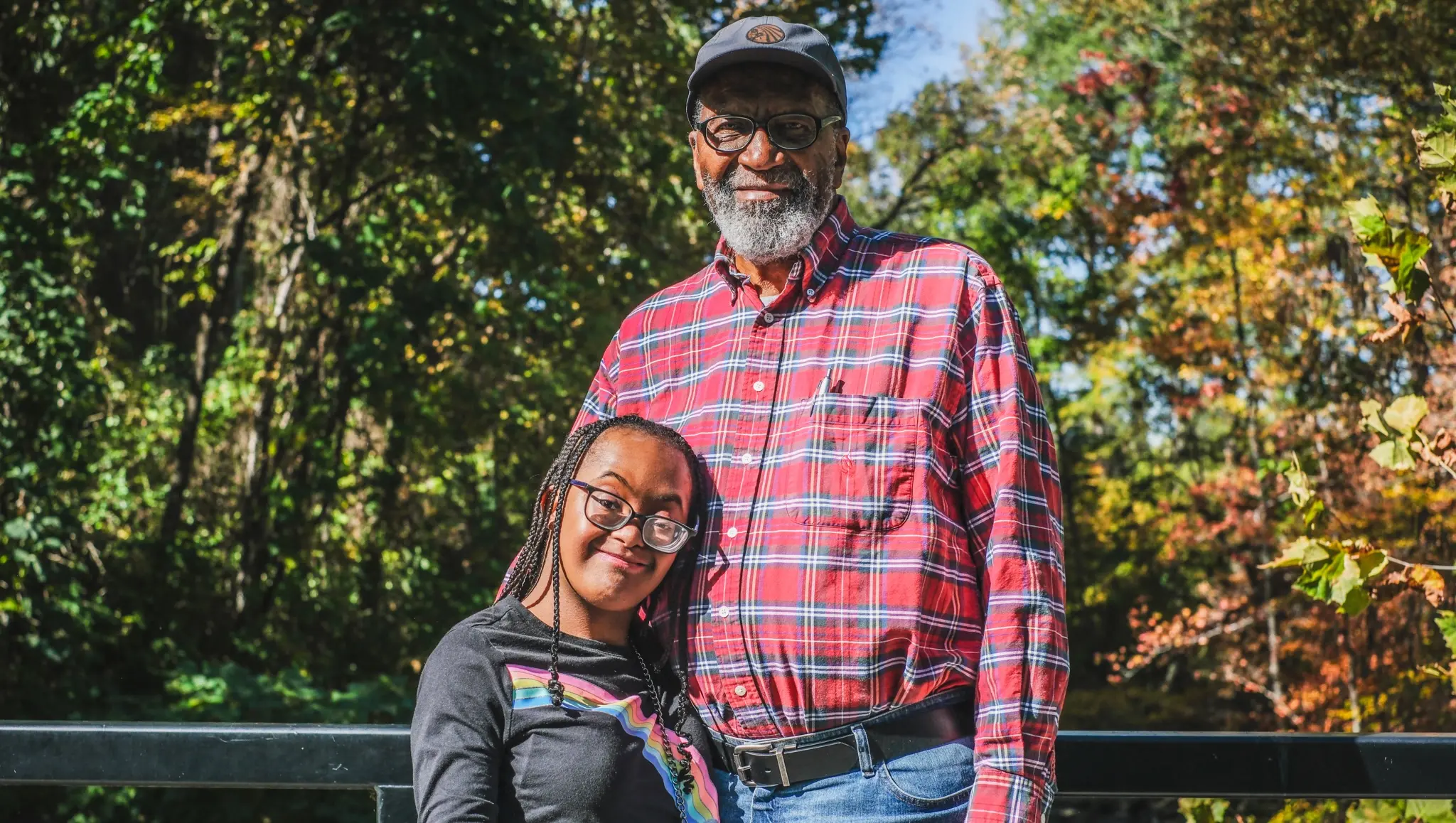
According to Yomi Noibi, “out of sight, out of mind” has historically been the City of Atlanta’s response to environmental pollution and flooding.
Noibi, who has a doctorate in science education with a concentration in environmental science and industrial hygiene, is an educator, community organizer, and former executive director—now consultant—for Environmental Community Action. Also known as Eco Action, the organization focuses on organizing and technical assistance solutions so that low-wealth communities and communities of color can empower themselves to find sustainable, environmental, and equitable solutions to environmental hazards. Flooding issues fall squarely within their water-focused work.
Streams, creeks, and rivers are natural drainage systems that absorb and guide rainwater. When we develop over and in spite of these waterways, rather than alongside them—when we cover more and more of the ground with asphalt and concrete and other impervious surfaces—stormwater instead flows into streets and neighborhoods and homes, Noibi explained. He pointed to Proctor Creek, Intrenchment Creek, and the Flint River as examples of waterways that have been piped underground or paved over for railways, roads, and other development: out of sight, out of mind.
“We have disturbed the natural harmony of water doing what it does best.”
—Yomi Noibi, Consultant for Environmental Community Action
“When the stream is covered, it harms the ability of the spring to do what it does naturally. Rather than being a blessing, it becomes a harm,” he said. “We have disturbed the natural harmony of water doing what it does best.”
In addition to using green infrastructure to retain and absorb water, Noibi believes development teams should not only be composed of engineers and architects, but also an interdisciplinary team of landscape ecologists, geologists, and hydrologists, who can work with the natural landscape and protect the environment.
Much of what has already been done to our waterways is very difficult, costly, and sometimes impossible to fully reverse, he continued, but there is a path forward: “Learn from it and do not do it again.”
Editor’s Note: This story was updated to add additional details to Dr. Noibi’s education, to clarify Eco Action’s mission, and add nuance to the final sentence. The story was originally published on November 20, 2025 and edited on December 3, 2025.
Caroline Smith,
Georgia Association of Water Professionals
Caroline Smith is a self-described “stormwater nerd” with the Georgia Association of Water Professionals. As director of stormwater programming and engineering, she helps facilitate stormwater trainings, of which few exist in the state, and she responds to regulations that affect water professionals, like the Environmental Protection Agency’s guidelines for water pollution.
Before joining GAWP, she worked in the City of Atlanta’s engineering department, focused on stormwater, infrastructure projects, and community engagement. She also investigated reports of flooding and helped determine causes, like old infrastructure or development on flood-prone land.
According to Smith, the City of Atlanta doesn’t own all of its stormwater system. In fact, most municipalities only own about 50 percent of their system. The rest is on private property or owned by state agencies. That means when a problem occurs, who exactly is responsible for resolving it varies street to street.
“It’s hard to find the money in the moment, but it’s harder to pay for it 20 years later when the problem is worse.”
—Caroline Smith, Director of Stormwater Programming and Engineering at the Georgia Association of Water Professionals
Another challenge Atlanta faces is that it doesn’t have a dedicated stormwater fund, unlike other cities comparable in size, like Raleigh, Detroit, and Omaha, all of which add stormwater fees to resident utility bills. Earlier this year, Mayor Andre Dickens raised the possibility of creating a stormwater utility, which could mean higher utility costs for residents, since that’s where many stormwater funds come from. The mayor says his administration is considering alternative solutions, but the City needs $2 billion to repair and update stormwater infrastructure, which includes thousands of miles of pipes. “There’s not a lot of funding,” Smith said. “Definitely more problems in the city than we have money to fix.”
That money could also make a big difference for the parts of Atlanta that historically have been underinvested in, she explained. “There has been a lot of investment to try to catch up, but it’s hard to catch up. And that’s the whole point of deferred maintenance,” Smith explained. “It’s hard to find the money in the moment, but it’s harder to pay for it 20 years later when the problem is worse.”

Alfred Tucker,
Stop Flooding Us
When Alfred Tucker signed up for a class through the Atlanta Watershed Learning Network, he thought it would be something simple, about creeks, streams, wildlife. What he didn’t expect was to find his life’s mission.
“Once I got into it and found out that it was environmental injustice that the class was concentrating on, it sparked an interest in me,” Tucker said. He soon joined other environmental justice causes, including a Proctor Creek restoration project. Today, he leads AWLN’s alumni group and is a member of the Proctor Creek Stewardship Council.
Eventually, Tucker met Yomi Noibi, who was, at the time, the executive director of an organization called Environmental Community Action. Yomi introduced him to a coalition dedicated to solving stormwater problems in Vine City and English Avenue called Stop Flooding Us.
“Once people know about it, they’re willing to give us their support.”
—Alfred Tucker, Organizer for Stop Flooding Us
Tucker had heard about flooding in those neighborhoods, but he didn’t know what caused it. The Gulch—a largely undeveloped, low-lying area near Mercedes-Benz Stadium—sits at the headwaters of Proctor Creek. With acres of concrete, asphalt, and other impervious surfaces preventing water from soaking into the ground, stormwater runoff from the Gulch flows downstream into Vine City and English Avenue during heavy rains, overwhelming those neighborhoods with floodwater.
When Noibi asked Tucker to help organize residents, business owners, and community leaders to pressure the City of Atlanta to address that flooding, Tucker didn’t hesitate. “It’s very heartening to know that once they find out about the flooding, they are very anxious to sign the petition,” he said. To date, Tucker said he’s collected more than 1,500 signatures. That reaction fuels him: “Once people know about it, they’re willing to give us their support.”

Contributed photo
Annie “Carla” Moore,
Green Team of English Avenue
On a quiet stretch of Lindsay Street in English Avenue, Annie “Carla” Moore has turned proximity into purpose. She didn’t set out to be an environmental advocate; she just lived next door to a park that needed care. “It wasn’t something I planned,” she said. “I just started pulling weeds.”
That simple act grew into something larger. Today, Moore leads the Green Team of English Avenue, a group of community members that maintain three stormwater management parks designed to hold and slow floodwater in a part of the City long burdened by environmental neglect: Lindsay Street Park, Kathryn Johnston Memorial Park, and Mattie Freeland Park. “After several years, I started understanding stormwater management,” she recalled. “By then, I had kind of taken on the role.”
“It wasn’t something I planned. I just started pulling weeds.”
—Annie “Carla” Moore, Leader of Green Team of English Avenue
Now, a few days a week, from April through October, Moore oversees a handful of neighbors who tend to the parks that help protect their homes from flooding and pick up litter before it can clog storm drains. She believes in locally led environmental restoration and envisions “green teams”—residents employed to maintain nearby parks—in every neighborhood, which, she believes, would create jobs and community pride. “At a grassroots level, we’re the ones who can fix our problems if we’re given the opportunity and the resources,” she said.

Daryl Haddock,
West Atlanta Watershed Alliance
When Darryl Haddock settled in Atlanta in the ’90s, community work wasn’t part of his plan. He was fresh out of school with a master’s degree in geoscience from Georgia State University, working for Georgia’s Department of Natural Resources and thinking about the next step in his career.
Then a small twist of fate changed everything: “My marriage announcement was in the Atlanta Journal-Constitution,” he recalled. “It said I was a scientist at the Department of Natural Resources, and a couple of people from the community came to my office and talked me into coming to community meetings. Here we are, 30-some years later, and I’m still doing community meetings.”
That chance encounter pulled Haddock into the world of environmental justice and, eventually, to the West Atlanta Watershed Alliance, better known as WAWA, a cornerstone for equity in underserved communities on the west side of Atlanta. Today, Haddock serves as its special projects director.
WAWA has three pillars: justice, education, and stewardship, Haddock said. At the heart of their work is the Outdoor Activity Center, a green sanctuary in the middle of the city—Southwest Atlanta’s Bush Mountain—where children and adults can reconnect with nature.
“It’s the boots on the ground—that’s really the power that we need.”
—Darryl Haddock, Special Projects Director for the West Atlanta Watershed Alliance
Haddock helps visitors understand that flooding is about how the land is treated. “We grade the land, remove the trees, and build bigger, longer, wider houses,” he said. “Where are all the raindrops going to go when they fall on all this impervious surface?” Haddock knows flooding, zoning, and stormwater aren’t particularly interesting or easy topics for most residents, so he focuses on connection over jargon. “When you’re waiting at a bus stop or you’re walking on a sidewalk, if you get splashed by water from the cars on the street, that is flooding. We’re not managing the storm water,” he explained.
Haddock credits his parents for where he is now. His father was a Black nationalist revolutionary, and his mother a teacher. As a young man, he resisted both paths. “God has a funny sense of humor,” he said. “I ended up doing both.”
Haddock said federal funding and political will have waned as the national landscape for environmental justice shifts. But he sees hope in local collaboration. “It’s the boots on the ground,” he said. “That’s really the power that we need.”


Leave a Reply